
Perforated solutions
Sheet perforation, from standard to bespoke industrial solutions.
TPS perforates from coil to produce perforated sheets ready to feed into your manufacturing processes.
Home » Perforated sheets
Our expertise is built on made-to-measure manufacturing, in both quantity and size. We do not hold stock of standard perforated sheets: every production run is made to the customer’s specifications and needs.
We work with a wide range of metals, thicknesses, sizes, perforation patterns and precision levels, including configurations that fall outside the usual market standards.
Industrial benefits
A perforated sheet builds a filtration, separation, ventilation, protection, material flow or weight-saving function directly into a metal part.
It offers several industrial benefits:
The perforation is part of the sheet itself, with no need for an added component.
Regular pattern, design perforation or random layout depending on the required function.
Dimensions, edges, solid areas and hole layouts can be defined to suit your needs.
The open area can be adapted to the functional and mechanical constraints of the application.
The sheet can be produced with the subsequent sheet metal operations in mind.
TPS manufactures to order, without relying on stocks of catalogue items.
An unusual geometry, size or quantity can be studied and put into production.
A perforated sheet is particularly relevant when perforation is a built-in function of the final part or an intermediate step in a wider industrial process.
Technical data
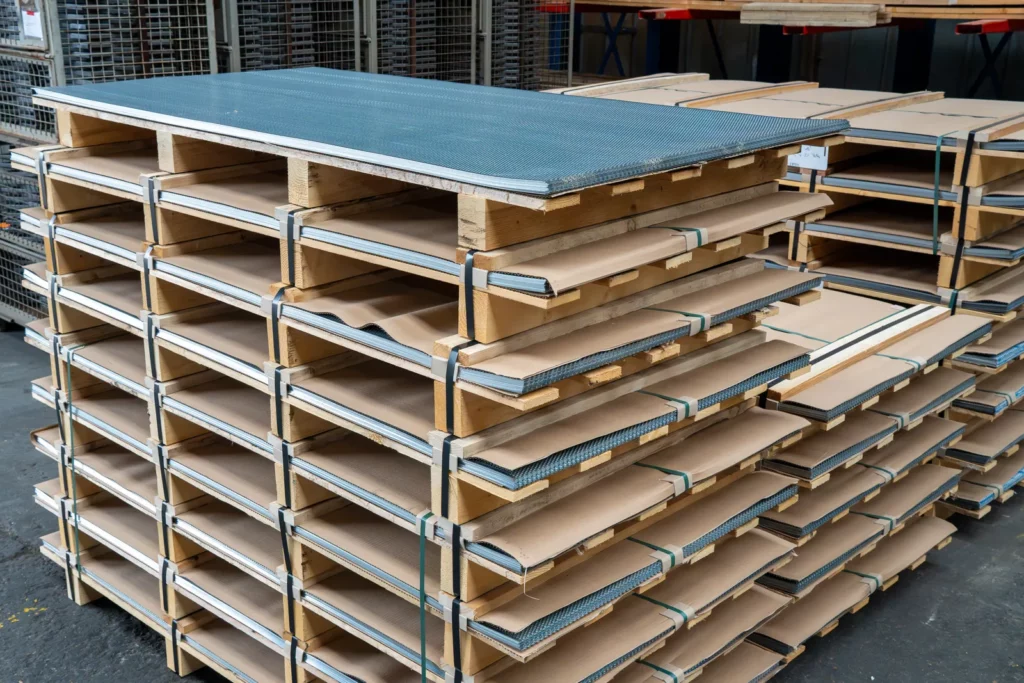
Every configuration is technically validated beforehand, because the feasibility of a perforated sheet depends on the interaction between material, thickness, size, pattern, pitch, edges, perforation process and dimensional requirements.
| Specification | TPS capabilities |
|---|---|
| Product | Custom perforated sheet |
| Materials | Carbon steels, stainless steels, aluminium and other alloys subject to study |
| Thickness | From 0.3 mm to 15 mm |
| Width | Up to 2,000 mm |
| Length | Up to 6,000 mm |
| Sizes | According to customer needs and production capacity |
| Hole shapes | Round, slotted, square, rectangular and specific geometries |
| Layout | Straight line, staggered and specific configurations |
| Perforation type | Regular, design or random depending on the application |
| Perforation pitch | Depending on pattern and functional and mechanical constraints |
| Unperforated areas | Possible depending on design |
| Edges | Perforated or unperforated as required |
| Process | Punching and suitable processes depending on geometry and application |
| Levelling | Available as required |
| Packaging | According to size, thickness and handling requirements |
| Inspection | Dimensional and visual checks to specification |
| Traceability | According to customer requirements and criticality level |
| Additional operations | All sheet metal operations subject to study |
Expertise
Perforating a sheet is not simply a matter of repeating a hole pattern on a metal surface.
The industrial challenge lies in controlling the product after perforation. Perforation locally changes the cross-section of the sheet and can affect its flatness, geometry, squareness and dimensional stability.
TPS’s expertise lies in controlling every parameter that can affect the quality of the finished product: material, thickness, pattern, geometry, consistency, open area, flatness, squareness and process stability.
Depending on the application, perforation can be regular and repetitive, with a defined pattern and pitch, or random when the required function does not call for a regular pattern.
Perforation can be achieved by punching, using a process suited to the material properties and the required geometry.
FAQ
Yes. TPS works with several families of metals. Feasibility does, however, depend on the grade, metallurgical condition, thickness, size and required pattern.
For a particular material, a feasibility study confirms the production conditions.
Yes.
The pattern geometry, hole diameter or shape, pitch, layout and solid areas can all be studied to suit the application.
A configuration that is not a catalogue standard is not necessarily impossible to industrialise.
Yes.
The width and position of the edges can be defined to suit your process. This is particularly useful when the sheet has to be cut, bent, formed or assembled after perforation.
Yes.
TPS also carries out toll perforation on customer-supplied material.
You send us your material, with its specifications and requirements, and we perforate it in line with your specifications.
This solution is particularly suitable when you already have a specific material, a qualified grade or a supply chain you want to keep.
Yes.
Our organisation allows us to study specific needs and batch sizes that do not necessarily fit very high-volume production.
The aim is to find the most cost-effective way of industrialising your requirement, rather than imposing a minimum batch size purely for internal reasons.
Yes.
A drawing, a CAD file, a technical specification or a sample can all serve as the basis for our study.
If your requirement is not yet fully defined, TPS can also help define the technical solution: material, thickness, pattern, pitch, edges, tolerances, levelling and sheet metal operations.
Your perforated sheet is not in any catalogue? That is exactly the kind of requirement we know how to industrialise.
TPS does not work from stocks of standard perforated sheets. We manufacture to order, in the size and quantity your project needs.
This approach lets us meet specific requests in terms of dimensions, geometry, material, quantity or preparation for subsequent sheet metal operations.
Send us your drawing, your specifications or simply the characteristics you have.
TPS works with you on technical feasibility, process constraints and cost to build a solution tailored to your production.
Search the site
Enter: see all results · Esc: close