
Perforated solutions
Continuous coil perforation, from standard to bespoke industrial solutions.
TPS carries out continuous perforation to produce perforated coils ready to feed into your manufacturing processes.
We work with a wide range of metals, thicknesses, widths, perforation patterns and precision levels, including configurations that fall outside the usual market standards.
Home » Perforated coils
Industrial benefits
Coil perforation lets you feed perforated material straight into a production line or a downstream processing operation.
It offers several industrial benefits:
Suited to high-volume requirements and automated processes.
Control of pitch, hole layout and repeatability over the full length.
The material arrives already perforated on the coil for downstream operations.
Cutting, slitting, forming, deep drawing, roll forming or assembly can be built into the production flow.
We can work directly to the dimensions your process requires.
Identification and tracking of material and production batches in line with your specifications.
TPS adapts the production method to your needs rather than imposing a standard product.
A perforated coil is particularly relevant when perforation is an intermediate step in a wider industrial process.
Technical data
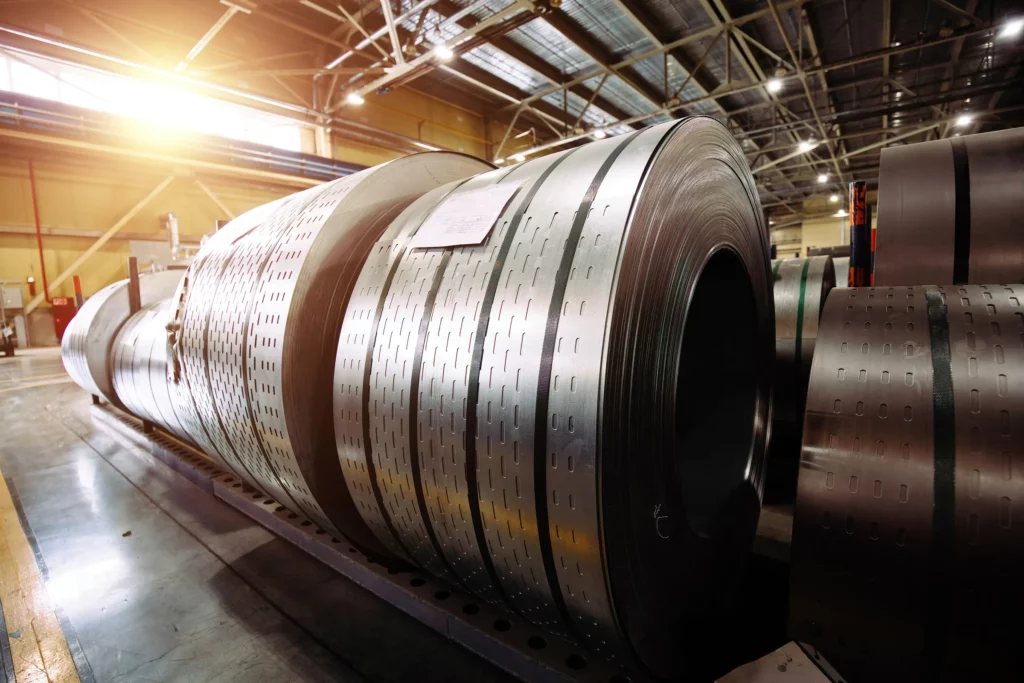
Every configuration is technically validated beforehand, because the feasibility of a perforated coil depends on the interaction between material, thickness, width, pattern, pitch, edges, production speed and dimensional requirements.
| Specification | TPS capabilities |
|---|---|
| Product | Perforated metal strip in coil form |
| Materials | Carbon steels, stainless steels, aluminium and other alloys subject to study |
| Thickness | From 0.3 mm to 3 mm |
| Width | Up to 1,500 mm |
| Length | Minimum 50 linear metres |
| Hole shapes | Round, slotted, square, rectangular and specific geometries |
| Layout | Straight line, staggered and specific configurations |
| Perforation pitch | Depending on pattern and mechanical constraints |
| Unperforated areas | Possible depending on design |
| Edges | Perforated or unperforated as required |
| Perforation | Continuous along the coil or interrupted (rewound blanks) |
| Packaging | Horizontal or vertical axis; eye to sky or on cradle |
| Inspection | Dimensional and visual checks to specification |
| Traceability | According to customer requirements and criticality level |
| Additional operations | Slitting, levelling and other operations subject to study |
Expertise
Perforating a strip continuously is not simply a matter of repeating a pattern over hundreds or thousands of metres.
The industrial challenge lies in keeping the process stable over the entire length of the coil.
TPS’s expertise lies in controlling every parameter that can affect the quality of the finished product (pattern, geometry, consistency, flatness, etc.).
FAQ
Yes. TPS works with several families of metals. Feasibility does, however, depend on the grade, metallurgical condition, thickness, width and required pattern.
For a particular material, a feasibility study confirms the production conditions.
Yes.
The pattern geometry, hole diameter or shape, pitch, layout and solid areas can all be studied to suit the application.
A configuration that is not a catalogue standard is not necessarily impossible to industrialise.
Yes.
The width and position of the edges can be defined to suit your process. This is particularly useful when the strip has to be guided, driven, cut or formed after perforation.
Yes.
TPS also carries out toll perforation on customer-supplied material.
You send us your material in coil form, with its specifications and requirements, and we perforate it in line with your specifications.
This solution is particularly suitable when you already have a specific material, a qualified grade or a supply chain you want to keep.
Yes, subject to technical validation.
Perforation changes the mechanical behaviour of the strip. The pattern, open area, hole position and material properties must therefore be studied in relation to the final geometry and the deep-drawing process.
Yes.
Our organisation allows us to study specific needs and batch sizes that do not necessarily fit very high-volume production.
The aim is to find the most cost-effective way of industrialising your requirement, rather than imposing a minimum batch size purely for internal reasons.
Yes.
A drawing, a CAD file, a technical specification or a sample can all serve as the basis for our study.
If your requirement is not yet fully defined, TPS can also help define the technical solution: material, thickness, pattern, pitch, edges, tolerances and packaging.
Your perforated coil is not in any catalogue? That is exactly the kind of requirement we know how to industrialise.
Send us your drawing, your specifications or simply the characteristics you have.
TPS works with you on technical feasibility, process constraints and cost to build a solution tailored to your production.
Search the site
Enter: see all results · Esc: close